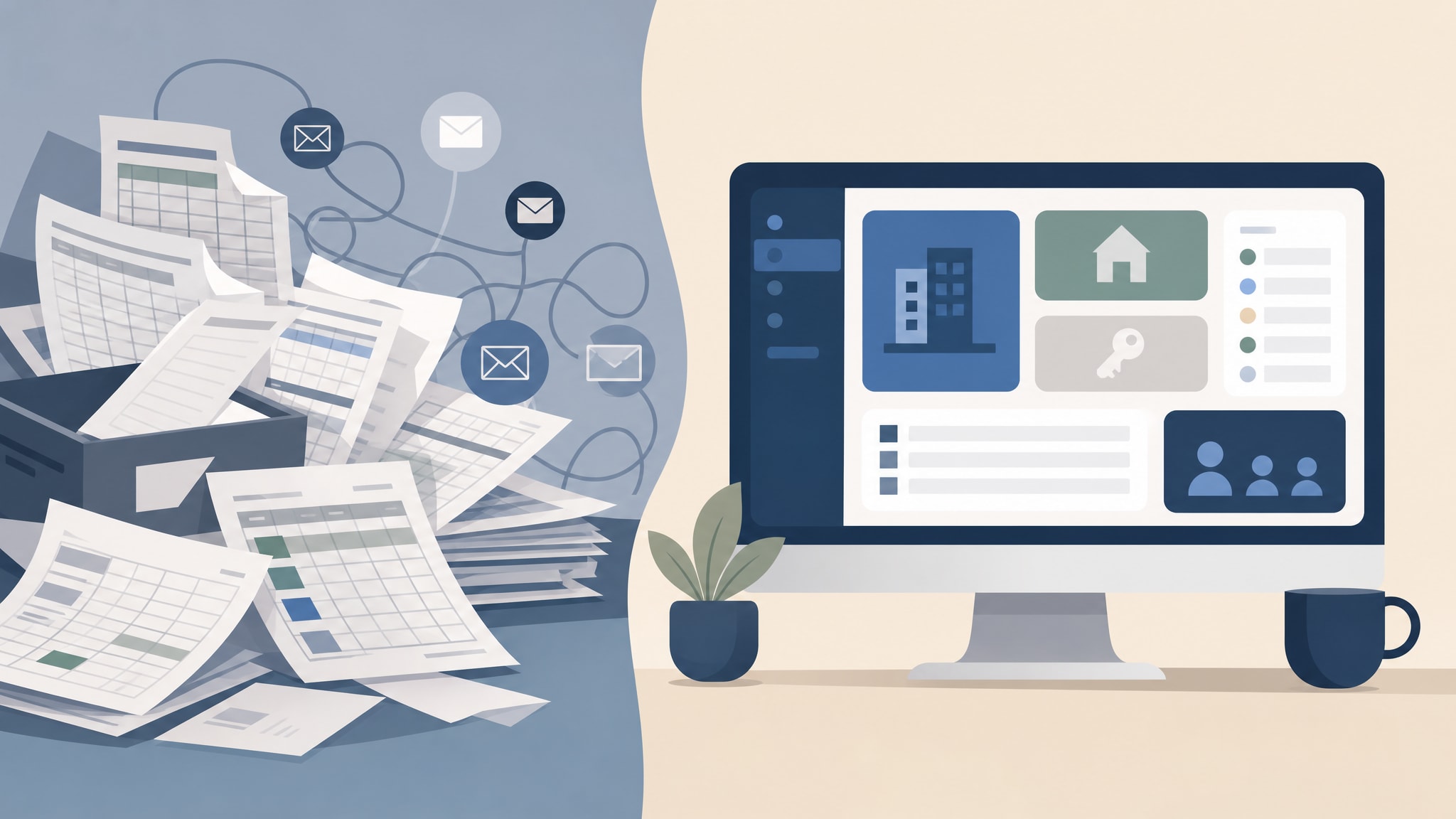
Most small businesses don't need enterprise software. But they do eventually outgrow the tools that got them started.
Custom software for small business isn't a luxury reserved for large corporations with IT departments anymore. It's a practical step for any company managing repeatable workflows that generic tools can't handle well. The decision to build a private internal system usually comes down to one moment: spreadsheets, email threads, and shared folders stop keeping up with daily reality.
This guide explains what custom internal software actually means for growing operations, how to recognize when you've reached that transition point, and how to scope a project without any technical background. It focuses on real operational problems in property management and construction, showing how a system built around your specific workflows can replace fragmented manual processes.
What Custom Software Actually Means for Small Operations
Custom software for small business is a private, web-based system built around your specific records, tasks, and statuses, instead of forcing your operations into someone else's template. Mass-market SaaS products try to serve every industry at once. This approach does the opposite: it builds a digital workspace that mirrors how your team already manages properties, projects, contractors, or payments.
You get only the features your business actually uses. No paying for unused modules, no navigating menus designed for someone else's workflow.
The goal is to bring customers, jobs, documents, and communications into one place so information flows naturally between tasks. A property manager tracking rent arrears should see maintenance history and tenant contact details in the same view. A construction supervisor needs progress photos and subcontractor invoices linked to the same job record. Built this way, the system cuts out the constant copying and pasting between disconnected apps that slows down growing teams and introduces errors.
Signs Your Business Has Outgrown Spreadsheets and Generic Tools
Operational friction builds slowly, long before it turns into a crisis that threatens growth or client relationships. Maybe finding a specific maintenance request means searching through three different email accounts and a shared drive. Maybe updating a project status means editing a spreadsheet that someone else overwrote yesterday.
These aren't just annoyances. They're signals that your current tools can't support the volume or complexity of your repeatable processes. When your team spends more time managing the tool than doing the actual work, you've crossed the threshold where custom software for small business becomes a real option. That usually happens once you have enough repeatable operations, managing tenants, tracking job sites, processing payments, that the overhead of manual coordination costs more than building a dedicated system would.
If you find yourself creating new workarounds every month just to handle basic tasks, your business has likely outgrown its current setup.
Generic tools are good at broad categories like accounting or communication, but they rarely connect those functions to your specific operational reality. A construction company might use one app for scheduling, another for document storage, and WhatsApp for field updates, and still have no single source of truth for project progress. That fragmentation creates blind spots that hurt decision-making. Every new employee or project multiplies the coordination burden instead of easing it.
Custom Software vs Off-the-Shelf SaaS for Growing Companies
Choosing between custom software and off-the-shelf SaaS really comes down to one question: do you adapt your business to the software, or the software to your business? Generic platforms make you modify your workflows to fit their predetermined structure, which often means abandoning the nuanced processes that give your company its edge. You end up paying monthly fees for features you never use, while still keeping separate spreadsheets for the details the platform doesn't capture.
A custom internal system flips this. It encodes your actual operations into the software itself. Property management companies can consolidate tenant records, rent payments, maintenance requests, and contractor communications into a single private platform that reflects their exact approval chains and reporting needs. Construction firms can replace scattered job site documentation with tools that track projects, subcontractors, progress photos, and issues in one system built around their project lifecycle.
This alignment cuts training time, because the software already matches what employees know, and it removes the data silos that form when teams patch together multiple generic tools. SaaS still makes sense for universal functions like payroll or email. But the operational workflows that actually define your business are better served by software built specifically for them. The trade-off isn't cheap versus expensive anymore. It's renting flexibility you can't change versus owning a system that evolves with you.
Real Examples of Custom Internal Systems in Action
Abstract descriptions of custom software for small business rarely show how these systems work day to day. Concrete examples make the difference between a generic tool and a system built around your specific business clearer, especially if you're not technical.
Property Management Workflows
Property managers juggle tenant relationships, financial tracking, maintenance coordination, and owner reporting across dozens or hundreds of units at once. A custom system brings these together so clicking on a property reveals lease terms, payment history, open maintenance tickets, and contractor assignments in one view. Instead of chasing updates by text message or digging through filing cabinets, staff can log inspections, assign repairs, and generate owner statements from the same screen where they track rent collection.
This cuts administrative overhead and makes sure nothing falls through the cracks during staff turnover or portfolio growth. You can see real system examples showing how these workflows translate into actual interfaces built for property management companies.
Construction and Job Site Tracking
Construction operations mean coordinating subcontractors, materials, schedules, and compliance documentation across multiple active sites with conditions that change daily. Custom tools let project managers upload progress photos directly from mobile devices, link them to specific tasks, and automatically notify the subcontractors who need to know about an issue. Budget tracking connects to daily logs, so cost overruns surface immediately instead of at month-end reconciliation. Document versioning makes sure everyone works from current plans instead of outdated prints stored in someone's truck.
These systems replace the patchwork of group chats, paper forms, and cloud folders that usually fragments job site information. The result is a single source of truth that travels with the project from bid to closeout, giving owners and managers visibility without constant status meetings.
The True Cost of Building Custom Business Software
Budget concerns keep many small businesses from even exploring custom software. Some of that fear is earned: large-scale projects have famously run into the tens of millions when requirements drift and billing is hourly. But that risk comes from open-ended engagements, not from custom software itself. Fixed-price models have made tailored systems accessible to companies without enterprise budgets.
1000FLAT builds custom internal business software for a fixed $1,000 price. Defined scope and simple pricing remove the financial uncertainty people usually associate with custom development. This works because the system focuses on core operational workflows instead of replicating every feature of enterprise platforms, which keeps complexity manageable and costs transparent. You know exactly what you'll pay before development begins. No surprise change orders, no per-user fees that pile up as your team grows.
The real comparison isn't against free spreadsheets. It's against the cumulative cost of multiple SaaS subscriptions, lost productivity from fragmented tools, and errors from manual data entry. Add that up, and custom software often pays for itself within months by cutting administrative overhead and preventing costly mistakes.
How to Scope a Custom System Without Technical Expertise
Defining requirements for custom software for small business doesn't require understanding databases or programming. Good scoping focuses entirely on business outcomes: what records you need to track, what statuses those records move through, who needs access to which information, and what actions should trigger notifications or updates. Think in terms of daily tasks and information flow, not technical specifications. Developers can translate operational logic into code once they understand how your business actually runs.
Start by mapping your most critical workflow from beginning to end. Note every person involved, every document referenced, every decision point. Identify where information currently lives, in spreadsheets, emails, or paper files, and describe what should happen instead when a task completes or a status changes. This operational blueprint is your requirements document, and it's worth more than any technical spec you could write without development experience.
You don't need to know how the system will be built to know what it needs to do for your team. Reviewing how the process works can help you see how operational descriptions turn into delivered software, no technical background required.
Getting Started With Your Own Private Business System
Moving from fragmented tools to a unified custom platform starts with an honest look at your current pain points. Document the specific workflows causing friction. Estimate how much time your team spends on manual coordination. Identify the information gaps that lead to errors or delays. This clarity keeps scope creep in check and makes sure the resulting system solves real problems instead of imagined ones.
Custom software for small business isn't for companies still figuring out their core operations, or those with fewer than five repeatable processes. It suits businesses with established workflows worth preserving and optimizing, where building costs less than continued fragmentation. If your operations are stable enough to describe clearly but complex enough to strain generic tools, you're likely in the sweet spot for a custom internal system.
When you're ready to find out whether a private system makes sense for your business, you can start your project with a conversation about your specific workflows, not a sales pitch.
Frequently Asked Questions
How much does custom software cost for a small business?
Custom software for small business can cost as little as $1,000 when built with a fixed-price model and clearly defined scope. Traditional custom development often costs tens of thousands due to hourly billing and scope creep, but focused internal systems that address specific operational workflows avoid that expense by limiting complexity upfront. The key is defining exactly what the system must do before development begins.
What software is best for a small business?
The best software depends on whether your operations fit neatly into generic categories or require specialized workflow tracking. Universal tools like accounting software or email platforms work well for standard functions, but businesses with unique operational processes often benefit more from custom internal systems. If your team constantly adapts generic tools to match your workflows, custom software may serve you better than another SaaS subscription.
Can I create my own software without coding knowledge?
You can define and commission custom software without writing code yourself by focusing on operational requirements rather than technical implementation. Describe your workflows, records, statuses, and information needs in plain business language, and let developers handle the translation to code. Fixed-price providers specialize in converting operational descriptions into working systems without requiring clients to manage technical decisions.
What are practical examples of custom software for small business?
Property management companies use custom systems to track tenants, rent payments, maintenance requests, and contractor communications in one platform. Construction firms build tools that connect job site photos, subcontractor assignments, progress tracking, and document versioning to specific projects. These systems replace fragmented spreadsheets and messaging apps with centralized platforms that mirror how each business actually operates.